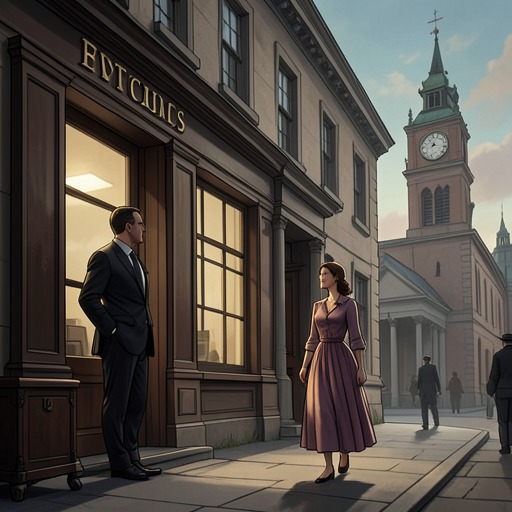
Octavio Machuca
La piel del tamborOctavio Machuca is the founder and president of Banco Cartujano, a formidable old financier whose influence reaches from the bank’s boardroom to the fate of Nuestra Señora de las Lágrimas. He helped raise Pencho Gavira into the bank’s leadership by making him his son-in-law, yet refuses to spare him the struggle that comes with power. A habitual observer of the life of Seville, Machuca watches Gavira’s plans, his marriage and his own approaching retirement with the same hard, sardonic attention.
Identity and Background
Machuca has spent years conducting his business not from the bank’s imposing Arenal offices but from a table at La Campana, where he reads the newspaper and receives whoever needs to deal with him. His routine gives the city’s commercial heart the air of an informal office: employees and clients, including Gavira, have to come to him there. Breakfast is coffee with milk and half a mollete from Antequera; the newspapers, passersby and daily shoe-shine are part of the same practiced vigil. His authority does not depend on being behind a desk.
The history behind that authority is rougher than the polished setting suggests. Machuca was a diver and smuggler in his youth, passed through moneylending in Jerez, and became a banker in Seville before he was forty. By the time the story finds him, he is very tall and thin, with a hooked nose, long, age-spotted hands and dark eyes ringed by the hollows of habitual sleeplessness. Age has brought those eyes exhaustion, not tenderness. The man who founded Banco Cartujano is approaching retirement, but remains alert to the appetites, risks and rivalries that sustain his world.
The Bank and the Church Redevelopment
Machuca’s power is exercised through transactions as well as temperament. He has just absorbed Banco de Poniente after methodically bringing it to ruin, and the old rival’s headquarters stands opposite his regular table at La Campana. This victory is one element in Gavira’s larger bid for control at Banco Cartujano; the younger executive must still negotiate almost daily with the man whose support created his position.
The proposed redevelopment of Nuestra Señora de las Lágrimas is larger still. Gavira describes a three-thousand-square-metre site in Santa Cruz and connects it to the expected sale of Puerto Targa to Saudi investors, a deal he values at 180 to 200 million dollars. Machuca understands that the church project is not a separate charitable or property matter: it is part of the financial structure meant to bring the Puerto Targa transaction to fruition and consolidate Gavira’s authority. He instructs Gavira to pay Archbishop Aquilino Corvo the compensation Corvo has suggested for facilitating the church’s secularization, the parish priest’s eviction and the church’s demolition. The exchange is presented as a practical price for clearing obstacles, and Machuca reminds Gavira that the money being spent is his.
That arrangement is vulnerable at its foundation. A documented family privilege from 1687 lays down conditions whose breach could return the church land to the Bruner family, while a nineteenth-century law associated with the confiscation of church property could instead direct the land to Seville’s municipality if it were secularized. A lawsuit by Cruz Bruner and Macarena Bruner could delay the project. Machuca’s brisk instructions therefore conceal a tangle of ecclesiastical authority, old property rights, municipal law and bank strategy. He can press the archbishop and direct Gavira’s spending, but he cannot make the legal and political risks disappear.
The danger becomes clearer in Banco Cartujano’s internal investigation. The bank had justified rising assets and interbank debts as temporary financing for Puerto Targa, supposedly to be regularized by an imminent sale to the Saudi-backed Sun Qafer Alley. Puerto Targa’s original capital was five million pesetas; after a capital increase to nine billion, the bank acquired 78 percent of its shares at Gavira’s instigation. The investigation found that the company remained almost wholly financed by Banco Cartujano through a complex structure involving Gibraltar companies, and that the bank had effectively sold the company to itself to book 7.02 billion pesetas as fictitious income. The later sale was meant to help cover a hole of more than 10 billion pesetas, while concealed risks eventually came to 20.028 billion.
The report also identifies false accounting, expensive and inadequately documented payments, possible bribes, and a dangerous dependence on the still-uncompleted sale. It warns that failure could put the bank in grave difficulty and that public knowledge of both the Puerto Targa scheme and the church transaction could alienate the bank’s traditionally conservative, often Catholic clientele. The source of the evidence matters: the plan is not simply Gavira’s bid for promotion but a high-risk attempt to buy time for a bank carrying losses and mismanagement. Machuca is nearing retirement and says the operation is Gavira’s; nevertheless, the exposure of the bank’s finances threatens the institution over which Machuca presides and the legacy he leaves behind.
Patronage, Marriage and the Test of Gavira
Machuca’s relationship with Gavira is inseparable from Macarena Bruner. He has known her family for forty years. When her father, Rafael Guardiola, ruined the family through failed ventures and died, Machuca handled the creditors, sold the remaining unembargoed properties and arranged matters so that the family retained its residence at Casa del Postigo and an annual income for the widowed Cruz Bruner. Seville gossips speculate that the income comes from Machuca’s personal funds and that his attachment to the family went beyond business. They also wonder whether his concern for Macarena reflects a paternal affection. The narration leaves these claims as rumor, not established fact.
Machuca later tells Gavira plainly that he appointed him vice-president because Gavira married Macarena. He considered Gavira a capable mind and a good future for her, but now says the bank matters less to him than Macarena and her mother. This admission recasts Gavira’s rise: professional ability counted, but family allegiance was the condition that placed him in power. Gavira knows this and has never pretended otherwise. Even so, he promises Machuca that he will recover Macarena, who has separated from him after their disagreements and the conflict over her wish to have a child immediately. Gavira says his struggle to establish himself at the bank left him unwilling to make time for a baby, and that Macarena’s departure became a declaration of war.
Machuca does not offer to intervene and persuade Macarena or her mother to be more reasonable. Instead, he explains that he could have let her marry any fool; what pleased him was seeing Gavira fight, as one might watch a horse, boxer or fighting cock. The comparison makes his affection and his cruelty difficult to separate. He has invested in Gavira, but does not treat protection as the purpose of that investment. He wants to see what the younger man can withstand, and leaves him to earn the outcome.
Power, Risk and the Meaning of Victory
Machuca’s counsel to Gavira is shaped by his own past. He recalls carrying his first smuggled cargo through Gibraltar after the war and later buying the bank, living for years with sleepless nights and fear. Only after crossing the finish line, he says, did the danger cease to matter; until then, Gavira must keep paying interest without complaint. The advice is both a lesson in endurance and a warning: security belongs to the survivor who has already passed beyond reach, not to the ambitious man still climbing.
Gavira’s immediate position bears out the difference. The bank’s board is impatient; some directors are waiting for him to fail. The Saudi investors are expected to arrive shortly before a board discussion of the church project, and Gavira assumes that a signed Puerto Targa agreement will quiet opposition. Machuca knows the timing and the pressure but does not guarantee success. He says that the operation is Gavira’s and that his own retirement is set for October; whether the plan succeeds or fails, he expects little change to his own life, though it may change Gavira’s entirely. His detachment is not ignorance of the stakes. It is a refusal to take responsibility for the younger man’s wager.
The image of the candle extinguished by Death in Valdés Leal’s In Ictu Oculi gives that wager a sharper edge. When Archbishop Corvo remarks on the painting’s proximity to men of their age, Machuca describes Gavira as a triumphant man who does not fear having his candle put out. The joke is also a contrast: Machuca and Corvo understand that status cannot protect anyone from death, while Gavira’s success still rests on deals that may collapse. When Corvo leaves after Gavira has pressed him, Machuca dryly observes that Gavira has offended the archbishop’s pastoral dignity; Gavira answers that dignity has a price the bank can pay. Machuca’s world translates moral and institutional authority into negotiable costs, but the painting makes the limit of that calculation visible.
By the later confrontation over the church, Macarena has explained the situation to Machuca in Quart’s presence. When Machuca asks Gavira what he knows, Gavira denies knowing anything. The question puts him under scrutiny in front of the people whose interests and history he has tried to manage: his wife, his patron and the priest charged with investigating the church affair. Machuca’s role has shifted from quietly enabling the redevelopment to demanding an answer. His composure does not settle the question, but it exposes how precarious Gavira’s position has become.
Narrative Role
Machuca links the novel’s private and institutional conflicts without reducing either to the other. The church’s threatened demolition is tied to the bank’s finances; the bank’s succession struggle is tied to Gavira’s marriage; and the old banker’s patronage binds these interests together while leaving them in conflict. He is at once the person who gave Gavira his opportunity and the person who insists that opportunity must be tested rather than secured for him.
His habitual place in the street, his appetite for watching others contend and his refusal to rescue Gavira make him a figure of power at rest: an observer whose influence is strongest when other people must come to him. Yet retirement is approaching, his bank carries concealed risks, and the transactions arranged under his authority may expose it to public and financial ruin. Machuca’s apparent indifference is therefore not the absence of stakes. It is the stance of a man who has survived enough dangers to leave the next one, deliberately, in someone else’s hands.